

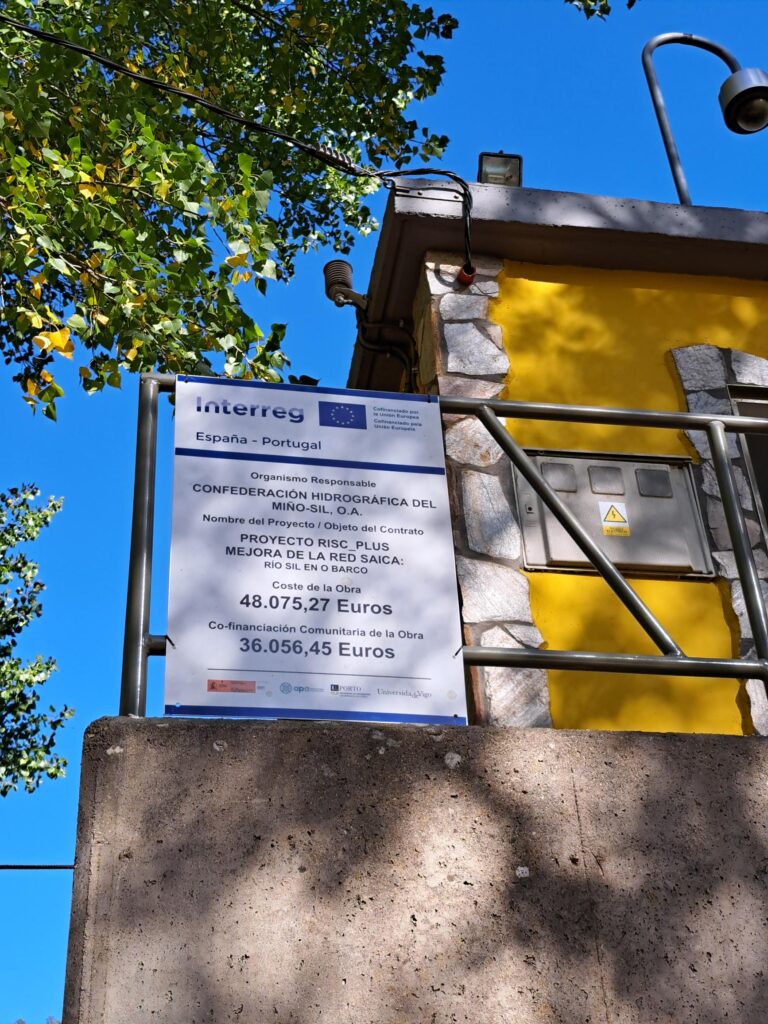
The Miño-Sil region has 123 stations that provide hydrological information (SAIH), 20 of which are equipped with specific technology to also provide water quality data (SAICA)
In an effort to improve the management and control of water resources, the Miño Hydrographic Confederation -Sil (CHMS), an autonomous body under the Ministry for Ecological Transition and Demographic Challenge (MITECO), has installed a new station of the Automatic Water Quality Information System (SAICA) on the River Sil, as it passes through the municipality of Barco de Valdeorras in Ourense.
The work consisted of installing a multi-parameter probe that will provide real-time data on physical and chemical variables that are important for water quality, such as turbidity, dissolved oxygen, conductivity, ammonium concentration, pH and water temperature.
This system makes it possible to detect accidental pollution incidents that may occur in this body of water and to act more quickly and effectively. It will also enable better diagnosis and continuous monitoring of the state of the Sil River’s water body.
The data is sent from the new station to the CHMS basin control centre (CECU) in the city of Ourense via satellite, with a value for each variable being received every fifteen minutes. This data is published on the CHMS website for public consultation.
This new station is part of the project to expand and improve the SAICA network within the framework of the RISC_PLUS Project, whose objective is to design joint measures aimed at prevention, preparedness, protection, prediction and better management extreme phenomena such as floods, droughts and accidental pollution, as well as to assess and combat the effects of climate change in the international demarcation of the Miño, Sil and Limia river basins.
The work in Barco involved a total investment of €55,526.45, of which €48,075.27 was for the execution of the work and €7,451.18 was for technical assistance and health and safety coordination.
‘The Miño-Sil basin has 123 stations that provide hydrological information (SAIH), 20 of which are equipped with specific technology to also provide water quality data (SAICA),’ concluded Carlos Guillermo Ruiz del Portal, head of the Hydrological Planning Office.
POCTEP RISC_PLUS, a project co-funded by the FEDER
The actions carried out under the POCTEP RISC_PLUS project are co-financed by the European Regional Development Fund (ERDF) through the Interreg VINE A Spain-Portugal (POCTEP) 2021-2027 programme, which promotes cross-border cooperation projects with the support of the European Union. Of the investment in the Sil River station in Barco, which amounts to €55,526.45, €36,285.75 is covered by the European POCTEP RISC_PLUS project.


