

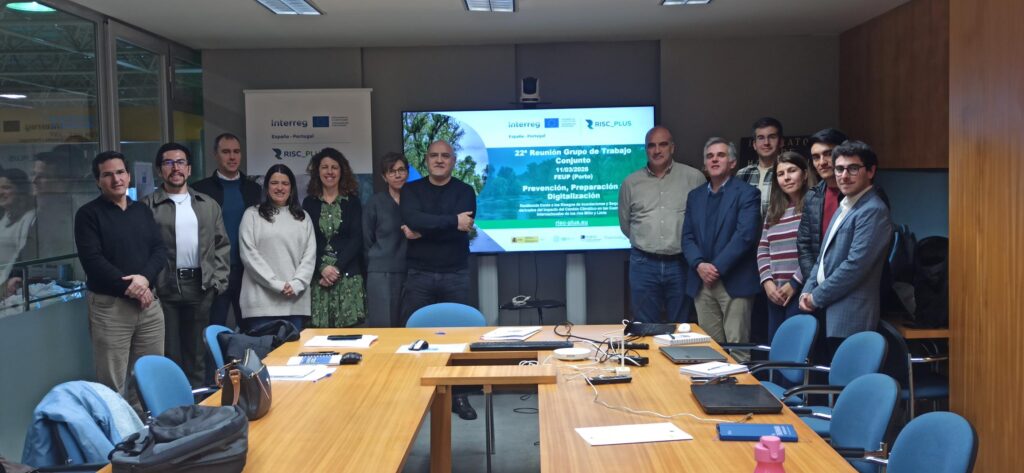
Progress on the MIDAS flood warning system, drought indicators and the socio-economic studies carried out as part of the project were also presented at the meeting held at FEUP
The European RISC-PLUS project has just held its 22nd Joint Working Group meeting at the Faculty of Engineering of the University of Porto (FEUP), where the partners analysed the project’s progress, the technical advances achieved and the next steps to finalise the results of this cross-border cooperation initiative.
During the meeting, representatives of the participating organisations reviewed the project’s overall progress, highlighting that financial implementation is now approaching 80%, reflecting the sustained pace of implementation of the various planned activities.
On the technical front, progress in the installation of monitoring infrastructure was highlighted. The Miño-Sil Hydrographic Confederation (CHMS) completed the installation of nine of the ten planned stations, whilst the APA-ARH Norte finished installing its seven hydrometric and meteorological stations, designed to strengthen environmental data collection in the region.
Another topic discussed was the development of the drought indicators created as part of Activity 2, tools that will improve the monitoring of this phenomenon and support decision-making in water management. In this context, the FEUP presented an assessment of seasonal rainfall forecasts and the validation process.
Regarding Activity 3, which focuses on flood analysis, the University of Vigo presented significant progress on the MIDAS system, highlighting the implementation of new servers that will enhance the system’s processing and data storage capacity—a key element for the integration and analysis of data generated by monitoring stations.
For its part, the FEUP presented the work carried out to improve the application of the MIDAS system in the Lima river basin, as well as the analysis of the episodes of heavy rainfall recorded during the first months of 2026.
As part of Activity 4, which focuses on socio-economic analysis, the University of Vigo presented the progress made in the study of the socio-economic impact of forest fires, a line of research aimed at gaining a better understanding of the consequences of these events on the local area.
The session concluded with a joint discussion on the next steps for the project. The partners also agreed to hold further technical meetings in the coming months to continue coordinating the work and make progress on the various lines of research and development.
Context of hydrological planning
The meeting also addressed the regulatory framework for water management, which is currently shaped by the public consultation on the Outline of Key Issues for the 2028–2033 hydrological planning cycle—the second stage in the development of the hydrological plan.
Through this meeting, the RISC-PLUS project strengthens collaboration between institutions on both sides of the border and continues to make progress in developing tools and knowledge aimed at improving the management of climate and environmental risks in the region.
This project, co-funded by the European Interreg Spain–Portugal (POCTEP) programme 2021–2027, is committed to solutions based on scientific knowledge, cross-border cooperation and technological innovation, to ensure efficient and sustainable water management in a context marked by climate change.


