

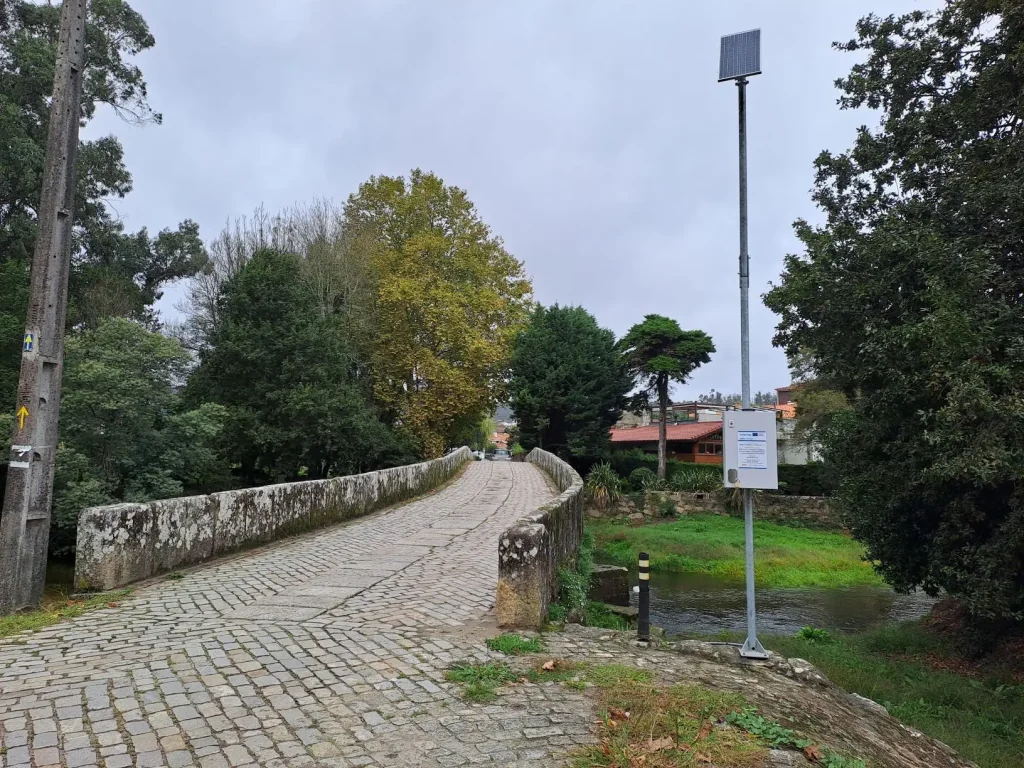
- The APA completes the implementation of new infrastructure that strengthens monitoring capacity in the Miño and Limia/Lima river basins.
- New equipment enables progress toward more reliable predictive models and more proactive climate risk management.
Ourense, November 17, 2025. The Portuguese Environment Agency (APA), a partner in the European RISC_PLUS project led by CHMS, has completed a new phase of installation and modernization of hydrometeorological stations in the Miño and Lima river basins. This action is part of Activity 1: Knowledge of the basin, specifically the improvement of control and information exchange networks, one of the fundamental pillars of the project.
The work has made it possible to expand and strengthen the monitoring network through the installation of four completely new stations in:
- Cavada (Caminha)
- Cerdeira (Vila Nova de Cerveira)
- Merufe (Monção)
- Segude (Monção)
In addition, the equipment and remote transmission systems of three other existing stations belonging to the APA’s Water Resources Monitoring and Alert System (SVARH) have been upgraded. These stations are located in:
- Extremo (Arcos de Valdevez)
- Nogueira (Viana do Castelo)
- Vila Nova de Cerveira
All stations incorporate state-of-the-art sensors and technology capable of continuously recording key parameters such as precipitation, flow, temperature, humidity, and water level. This data will improve the accuracy of hydrological models and advance the development of more effective early warning systems for extreme events such as floods and droughts.
The installation of these seven stations represents a significant step forward in improving shared hydrological knowledge and strengthening technical cooperation between Spain and Portugal in the international basins of the Miño and Limia/Lima rivers.
This project, co-financed by the European Interreg Spain–Portugal (POCTEP) 2021–2027 program, is committed to solutions based on scientific knowledge, cross-border cooperation, and technological innovation to ensure efficient and sustainable water management in a scenario marked by climate change.


