

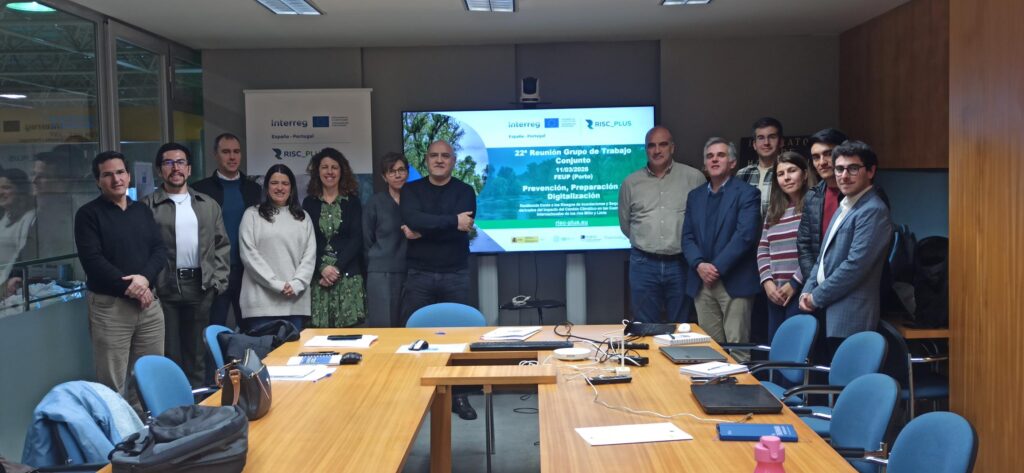
Both institutions, alongside the universities of Vigo and Porto, are participating in a European programme aimed at mitigating climate risks
The Faculty of Engineering at the University of Porto hosted the meeting of the joint working group for the European Risc-Plus project, which focuses on solutions based on scientific knowledge, international cooperation and technological innovation. The aim is to ensure efficient and sustainable water management, seeking to strengthen collaboration between institutions on both sides of the border and to develop tools aimed at improving the management of climate and environmental risks in the region. It is co-funded by the European Interreg Spain-Portugal (Poctep) programme 2021-2027. The Miño-Sil River Basin Authority, the Portuguese Environment Agency and the universities of Vigo and Porto are part of this project.
During the meeting, the partners highlighted that financial implementation is now approaching 80%, reflecting a steady pace in the roll-out of their activities. On the technical front, progress in monitoring infrastructure was highlighted: the Miño-Sil River Basin Authority completed nine of the ten planned stations, whilst the Portuguese Environment Agency finalised the installation of its seven hydrometric and meteorological stations. These tools are complemented by the development of drought indicators and the validation of seasonal forecasts presented by the University of Porto to support decision-making in water management.
With regard to flood analysis, the University of Vigo presented significant progress on the Midas system, through the implementation of new servers that enhance its processing and storage capacity. For its part, the University of Porto outlined the work carried out on this same system for the Lima river basin and the analysis of the episodes of heavy rainfall recorded during the first months of 2026. In addition, progress was discussed on the study of the socio-economic impact of forest fires, and the regulatory framework for the 2028–2033 hydrological planning cycle was analysed. The participating partners agreed to hold further technical meetings in the coming months to continue coordinating the work and make progress across the various lines of research.


